Family-friendly nap scheduling is the practice of fitting a child’s age-appropriate sleep into the family’s daily routine while protecting periods when the child is most alert and available for shared activities. A practical plan starts with age-based sleep guidance, then uses each child’s wake time, nap pattern, and evening bedtime to map likely high-energy windows. The American Academy of Sleep Medicine recommends 12–16 hours of sleep per 24 hours for infants aged 4–12 months, 11–14 hours for children aged 1–2 years, and 10–13 hours for children aged 3–5 years, including naps. These are total-sleep ranges, not fixed nap schedules: individual needs vary, and a nap should support rather than displace sufficient nighttime sleep. The sections below explain the evidence, age-related nap patterns, ways to identify peak performance windows, and how to build a flexible household schedule.
Nap Scheduling and Peak Performance Windows
A peak performance window is a practical planning term for a period when a child is comparatively rested, attentive, and ready for interaction. It is not a medical diagnosis or a precisely timed biological interval. Children’s alertness can shift with sleep quality, age, illness, activity, and the time since waking. Scheduling around these windows can make outings, learning activities, meals, and family time easier, while allowing naps to occur before a child becomes overtired.
The distinction between sleep opportunity and sleep requirement matters. The Centers for Disease Control and Prevention notes that recommended sleep duration is linked with children’s health and well-being; inadequate sleep can affect attention, behavior, learning, and emotional regulation. At the same time, not every child within an age band naps in the same way. A workable family plan therefore combines population-level guidance with observation of the individual child, rather than treating a sample timetable as a rule.
Age-Based Nap Needs and Daily Sleep
The American Academy of Sleep Medicine’s consensus recommendations define daily sleep duration by age, counting naps and nighttime sleep together. The figures offer a planning baseline, not a requirement that every child sleep for an identical number of hours or take a particular number of naps. Because nap patterns change as children mature, families should revisit the routine when the child’s wake time, bedtime, or daytime behavior changes consistently.
Infants: Flexible Sleep Opportunities
For infants aged 4–12 months, the recommended total is 12–16 hours per 24 hours, including naps. Infant sleep is often distributed across several periods, and a single fixed schedule may not reflect a baby’s changing needs. The American Academy of Pediatrics emphasizes safe sleep practices: place babies on their backs for every sleep, use a firm, flat sleep surface, and keep the sleep area free of soft objects and loose bedding. Scheduling should never override safe-sleep guidance.
For families, the useful “window” is often the time after a baby has woken, eaten, and had a chance for calm interaction—not a guaranteed number of hours of alertness. Caregivers can note sleep and feeding patterns for several days and plan flexible activities around them. If a baby is unusually difficult to wake, feeds poorly, or has concerning sleep or breathing symptoms, caregivers should seek advice from a pediatric clinician.
Toddlers: From Multiple Naps Toward One
Children aged 1–2 years are recommended to get 11–14 hours of sleep per 24 hours, including naps. Many toddlers transition toward one daytime nap during this period, but timing varies. A toddler who regularly seems sleepy well before the planned nap may need an earlier rest opportunity; one who resists a nap yet remains settled and alert may be moving toward a different pattern. These observations should be considered across several days, since an isolated difficult day is not enough to establish a new routine.
A toddler’s post-nap period can be a useful time for errands, outdoor play, or family activities, provided the child has had time to wake fully and eat or drink as needed. If a late or long nap repeatedly makes bedtime difficult, the family can discuss adjustments with a pediatric professional and consider whether the nap’s timing is affecting nighttime sleep. The aim is to protect the recommended total sleep, not to eliminate rest simply to fit an adult timetable.
Preschoolers: Nap, Quiet Time, and Night Sleep
For ages 3–5, the recommended total is 10–13 hours per 24 hours, including naps. Some preschoolers still nap; others no longer sleep during the day but benefit from a quiet rest period. A child who skips a nap should still have an age-appropriate opportunity for sufficient nighttime sleep. Families can use behavior and sleep records to distinguish a temporary missed nap from a durable change in daytime sleep needs.
Quiet time can preserve a predictable break without requiring sleep. A calm book, soft music, or independent play in a safe setting may help the child and caregiver transition through the middle of the day. If regular naps are followed by prolonged bedtime settling, or a child is persistently sleepy during daytime activities, the schedule may warrant review with a clinician.
Peak Performance Windows and Family Routines
A child’s peak performance window is best treated as an observed pattern, not a clock time prescribed for all children. The National Sleep Foundation describes sleep as essential to health and daily functioning, while pediatric sleep guidance consistently emphasizes adequate duration and regular routines. In practical terms, families can look for periods when a child is engaged and emotionally regulated, then place activities requiring cooperation or attention in those periods.
Recognizing Signs of Readiness and Fatigue
Readiness may show up as interest in play, steady attention, and a relatively calm response to ordinary transitions. Fatigue can appear as yawning, rubbing eyes, reduced engagement, irritability, or escalating difficulty with routine tasks. These cues are not unique to tiredness—hunger, discomfort, overstimulation, or illness can look similar—so caregivers should interpret them in context rather than use one sign as a definitive measure.
A simple sleep diary can help reveal patterns. For one or two weeks, record wake time, nap start and end, bedtime, night waking if relevant, and notable changes in mood or alertness. The diary is not a diagnostic tool, but it can help families see whether a recurring activity falls before a child’s nap, whether a late nap coincides with bedtime struggles, or whether a particular schedule consistently supports calmer afternoons.
Placing Activities Around Rest
When possible, schedule demanding or time-sensitive activities during a child’s more alert periods and leave room before naps for a predictable wind-down. Family outings, appointments, and group activities may not always fit neatly around sleep, so flexibility is important. If a nap must happen away from home, preserve familiar cues—such as a quiet transition, a comfort routine appropriate for the child’s age, and a safe sleep setting—without compromising safe-sleep recommendations.
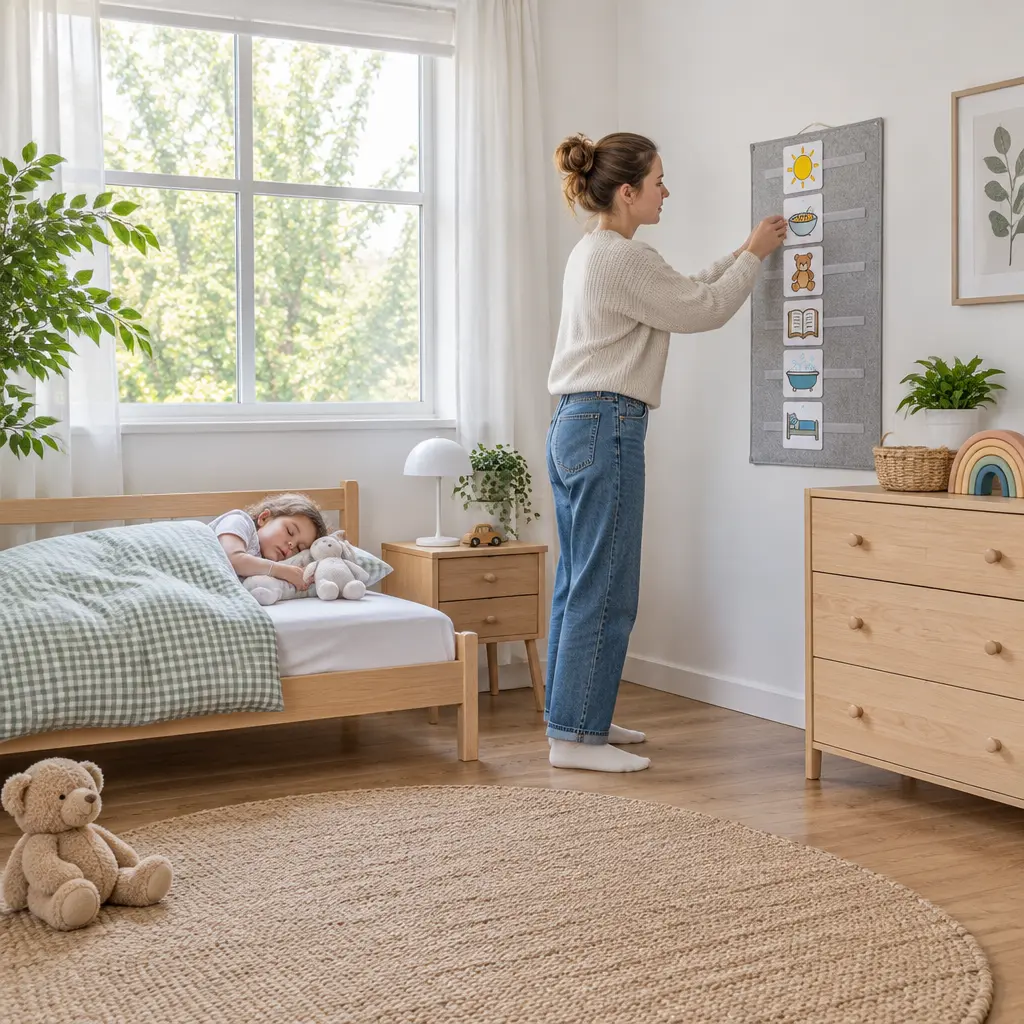
A practical day map can be organized around anchors rather than exact minute-by-minute targets: morning wake-up, meals, nap or quiet time, outdoor or active play, and a consistent bedtime routine. This helps caregivers coordinate school, work, siblings, and childcare while leaving room for normal variation. A chart may show wake time, nap opportunity, likely alert period, and bedtime as adjustable blocks; it should be treated as a planning aid, not a clinical prescription.
Building a Flexible Nap Schedule
A family-friendly schedule balances three considerations: total sleep across 24 hours, the child’s individual signs and patterns, and the household’s real constraints. The following process can help families create a plan without forcing every day into an identical timetable.
- Start with the child’s age-based total-sleep range from the American Academy of Sleep Medicine, counting naps and nighttime sleep together.
- Track actual sleep and daytime behavior for several days, noting wake times, nap timing, bedtime, and relevant disruptions.
- Identify recurring periods when the child is calm and engaged, and reserve those for activities that benefit from attention or cooperation.
- Protect a nap or quiet-time opportunity when the child’s pattern indicates a need for rest; avoid sacrificing needed sleep just to preserve an adult-preferred schedule.
- Review the plan after a persistent change, such as repeated nap refusal, a sustained shift in bedtime settling, or ongoing daytime sleepiness.
For example, a family with a toddler who regularly wakes early and becomes tired before lunch might try bringing the nap opportunity forward and placing a walk or appointment after the child has rested. If bedtime then becomes consistently difficult, caregivers can review the nap’s duration and timing alongside total sleep, rather than making abrupt changes based on one evening. This is an illustrative approach, not individualized medical advice.
When to Seek Guidance
A schedule adjustment may help with ordinary variation, but persistent concerns deserve professional input. Ask a pediatric clinician about ongoing excessive daytime sleepiness, frequent or prolonged night waking, loud habitual snoring, pauses or difficulty breathing during sleep, or a pattern that substantially affects feeding, behavior, learning, or family functioning. The CDC and American Academy of Pediatrics encourage families to discuss sleep concerns with healthcare professionals, who can consider the child’s age, health, development, and full sleep pattern.
Families should also be cautious about interpreting general sleep statistics as a diagnosis. Recommendations describe ranges for groups; only a qualified clinician can assess whether an individual child’s sleep pattern may be related to a health or developmental concern.
Conclusion: Match Rest to the Child, Not Just the Clock
Age-based nap needs provide a useful foundation, while observed peak performance windows help families decide when to place activities and transitions. Infants need flexible sleep opportunities, toddlers may move toward one nap, and preschoolers may need either a nap or quiet time alongside adequate night sleep. A brief sleep diary and a schedule built around daily anchors can make the routine more practical without treating any sample timetable as universal.
The broader lesson is that family scheduling works best when it supports children’s health and adapts to their development. Start with reputable sleep guidance, observe the child over time, maintain safe sleep practices, and consult a pediatric clinician when concerns persist. For further reading, review the American Academy of Sleep Medicine’s child sleep-duration recommendations, the CDC’s sleep guidance, and the American Academy of Pediatrics’ safe-sleep information.
Sources: American Academy of Sleep Medicine, Recommended Amount of Sleep for Pediatric Populations, https://aasm.org/resources/pdf/sleepdurationrecommendations.pdf; Centers for Disease Control and Prevention, About Sleep, https://www.cdc.gov/sleep/about/index.html; American Academy of Pediatrics, How to Keep Your Sleeping Baby Safe: AAP Policy Explained, https://www.healthychildren.org/English/ages-stages/baby/sleep/Pages/a-parents-guide-to-safe-sleep.aspx; National Sleep Foundation, How Much Sleep Do You Really Need?, https://www.thensf.org/how-many-hours-of-sleep-do-you-really-need/