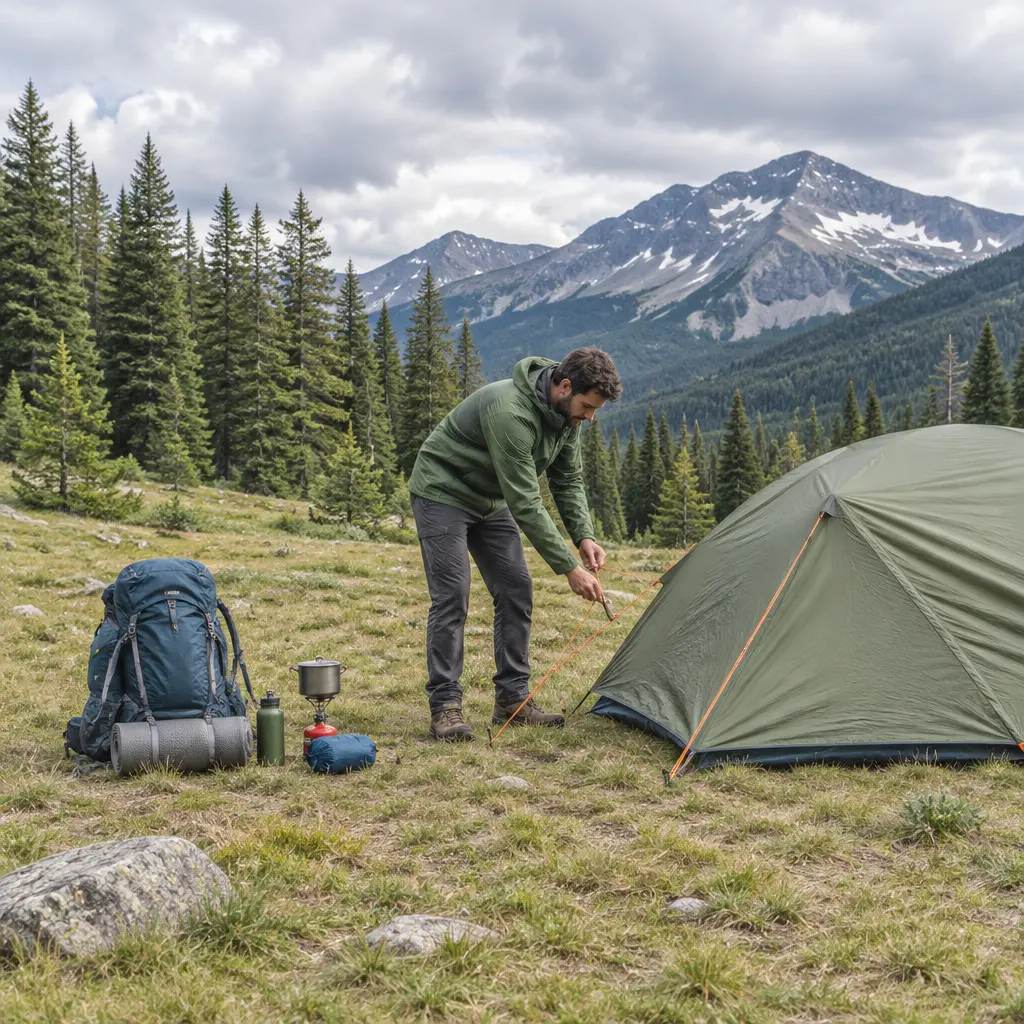
Camping gear optimization is the practice of selecting and arranging equipment to keep a load within a hiker’s carrying limit while preserving enough protection for the expected weather. The best setup is not simply the lightest: it balances pack weight, shelter and sleep-system performance, clothing, water management, and contingency needs against forecast uncertainty and terrain. That balance matters because the National Park Service advises hikers to prepare for changing conditions, while the National Weather Service warns that mountain weather can shift rapidly; a useful planning metric is therefore not just total weight, but the consequences of each weight-saving choice.
Balancing Weight Limits and Weather Resilience in Camping Gear
A practical approach starts by separating essential protection from convenience, then weighing each item and evaluating its function in the trip’s actual conditions. Compare complete systems—shelter, sleeping bag, sleeping pad, clothing, and rain protection—rather than isolated product weights. A light tent may require a separate groundsheet or additional stakes; a lighter sleeping bag may need warmer clothing or a more insulating pad. This article explains load planning, weather resilience, gear categories, and a repeatable method for making safer trade-offs.
How Camping Gear Weight Limits Shape Weather Resilience
A gear weight limit is a planned ceiling for the equipment and supplies carried by an individual or group. Backpacking practice commonly distinguishes base weight—the weight of gear carried before consumables—from total pack weight, which also includes food, water, and fuel. REI Co-op describes base weight as a useful comparison measure, but it is not a safety standard: the appropriate load depends on the hiker, route, trip length, and conditions.
Weather resilience is a system’s ability to maintain shelter, warmth, dryness, and function when exposed to conditions such as rain, wind, cold, heat, or snow. Its key attributes include coverage, insulation, ventilation, stability, durability, and redundancy. These attributes interact: a waterproof shell can reduce heat loss in wind and rain, but poor ventilation may increase condensation; a warmer sleeping bag helps in cold, but only if the sleeping pad limits heat loss to the ground.
The Centers for Disease Control and Prevention notes that hypothermia can occur when the body loses heat faster than it produces it, and wetness and wind can increase heat loss. That makes weather protection a functional requirement, not merely a comfort upgrade. For planning, examine the forecast, seasonal climate, elevation, exposure, and escape options, then retain enough weight for the hazards that would be consequential if they occur.
Base Weight, Consumables, and Total Pack Weight
Base weight includes durable equipment such as a pack, shelter, sleep system, clothing, and cooking kit. Consumables—principally food, water, and fuel—are used up during the trip, so total pack weight changes over time. Weighing both figures helps distinguish equipment choices from route-dependent needs. Water is especially variable: the National Park Service recommends carrying enough for the route and conditions and treating water when needed, rather than assuming a single fixed amount suits every hike.
Weather Protection as a System
A weather-protection system combines several components rather than relying on one “all-weather” item. A shelter sheds precipitation and resists wind; a sleeping bag or quilt limits heat loss; a pad insulates from the ground; and clothing helps manage moisture and temperature during activity and rest. The U.S. National Weather Service’s guidance to check forecasts and remain alert to changing weather supports building a plan around plausible conditions, not only the most favorable forecast.
How Shelter Weight Affects Weather Resilience
Shelter weight is the mass of the tent, tarp, bivy, poles, stakes, guylines, and any required footprint. The relevant comparison is the complete shelter package and its suitability for the site. A lower number on a product label does not by itself show how well the shelter handles wind-driven rain, condensation, or exposed campsites.
Tents, Tarps, and Bivies
A tent generally offers a more enclosed barrier against insects and weather, while a tarp can reduce carried weight but requires suitable pitching skills and site conditions. A bivy can provide compact coverage for an individual, though it may offer less living space and can be less comfortable in prolonged rain. These are hyponyms of shelter choices: each is a distinct form of camping shelter with different trade-offs in coverage, setup, ventilation, and weight.
Evaluate the shelter’s rainfly coverage, floor and seam construction, ventilation, stake points, and wind stability. REI Co-op’s tent guidance emphasizes matching tent design to expected conditions and campsite exposure. In practice, a minimalist tarp may work well in sheltered, predictable conditions but demand more judgment when storms, insects, or exposed terrain are likely.
Wind, Rain, and Condensation Trade-Offs
A shelter’s weather performance depends on both construction and setup. Use all required guylines, orient the shelter to reduce wind exposure where appropriate, and avoid low spots where water can collect. Ventilation helps control condensation, but opening vents during driving rain may require careful adjustment. A few extra stakes or guylines can be a small weight increase with meaningful value when the forecast or campsite is uncertain.
How Sleep-System Weight Affects Warmth and Safety
A sleep system combines insulation above and below the sleeper. Its components are a sleeping bag or quilt and a sleeping pad, sometimes supplemented by sleep clothing. Comparing only bag weight misses the pad’s contribution to warmth and the need to match the whole system to expected overnight conditions.
Sleeping Bags and Quilts
A sleeping bag encloses the body, while a quilt typically reduces material beneath the sleeper and may attach to a pad. Either can save weight when selected for appropriate temperatures and used correctly. Check the product’s temperature rating and understand whether it is a comfort, limit, or survival rating; these terms are not interchangeable. The International Organization for Standardization’s ISO 23537 standard provides laboratory methods for rating adult sleeping bags, but an individual’s comfort can vary with metabolism, clothing, fatigue, and conditions.
Sleeping Pads and Ground Insulation
A sleeping pad cushions the body and slows heat transfer to the ground. Its R-value indicates thermal resistance; higher values generally indicate greater insulation, though the required value depends on conditions and the rest of the system. ASTM International’s F3340 standard defines a test method for measuring sleeping-pad thermal resistance, helping consumers compare products tested under a common procedure. Choosing a very light pad without adequate insulation can undermine an otherwise warm bag.
For a cold or damp trip, prioritize a pad and bag combination suited to expected nighttime temperatures, including a reasonable margin for forecast error. In milder conditions, a lighter system may be appropriate, provided the user has clothing and a plan for an unexpectedly cool night.
How Clothing and Rain Gear Support Weather Resilience
Clothing weight is the mass of the garments carried or worn to manage temperature, wind, and moisture. The useful measure is the layering system’s performance across activity levels: a hiker may generate heat while climbing, then cool quickly during a stop. The National Park Service’s “Ten Essentials” guidance includes extra clothing as a preparedness item, reflecting the value of carrying protection beyond the clothes worn at the trailhead.
Layering for Activity and Rest
A layering system commonly includes a moisture-managing base layer, an insulating layer, and an outer shell that blocks wind or precipitation. Layers can be adjusted as exertion and conditions change. Avoid relying on a single heavy garment when several lighter layers offer more flexibility, but do not remove essential insulation simply to reduce pack weight if the route includes cold exposure or long stops.
Rainwear and Moisture Management
Rainwear includes waterproof or water-resistant jackets and trousers, while moisture management also includes dry sleep clothing and protective storage for critical insulation. A rain shell can reduce exposure to wind and precipitation, but no garment eliminates the need to regulate exertion and ventilation. Protecting the sleeping bag and spare layers in a pack liner or waterproof bags provides a second line of defense if the pack’s exterior becomes wet.
How Food, Water, and Safety Gear Fit the Weight Plan
Consumables and safety equipment affect total carried weight but should be planned separately from base weight. Their quantities depend on trip duration, resupply opportunities, water availability, route difficulty, and the consequences of delay. The National Park Service recommends carrying the Ten Essentials, a collection of navigation, illumination, first-aid, emergency, and other preparedness items; the exact contents should be adapted to the trip.
Food, Water, and Fuel
Food, water, and fuel are consumables whose mass decreases as they are used. Reduce avoidable weight through realistic meal planning, efficient cooking, and checking reliable water sources, but do not assume a source is safe without appropriate treatment. The U.S. Geological Survey explains that water suitability depends on physical, chemical, and biological characteristics; clear appearance alone does not establish that untreated water is safe.
Emergency and Repair Items
Emergency and repair items are small pieces of equipment that help respond to injury, navigation errors, gear failure, or unexpected exposure. Their weight is often modest compared with the potential cost of leaving them behind. Select them for the trip rather than carrying an unexamined collection: for example, a shelter repair item is more relevant when a damaged shelter could leave the group exposed overnight.
A Practical Method for Optimizing Camping Gear
A repeatable process makes weight decisions more defensible and reduces the risk of cutting essential protection. Use a scale and gear list, assess likely conditions, and test the complete setup before relying on it in remote terrain.
- Set the trip’s constraints: route, duration, elevation, forecast, season, water access, and bailout options.
- List every item and record its weight, purpose, and whether it is shared, worn, or consumed.
- Separate base weight from food, water, and fuel so that consumables do not obscure equipment comparisons.
- Identify critical functions—shelter, insulation, rain protection, navigation, and emergency response—and do not remove a function without a workable substitute.
- Compare complete systems, including required accessories such as stakes, guylines, pad, repair kit, and waterproof storage.
- Trim duplication and nonessential comfort items before reducing protection needed for the expected conditions.
- Test the kit in a low-consequence setting, then revise the list based on actual comfort, condensation, setup time, and performance.
A useful gear table can record item, weight, weather function, failure consequence, and possible alternative. This functions as a simple decision chart: retain high-consequence protection, optimize heavier items that perform the same job, and reconsider low-value duplicates. It also makes shared equipment visible, so a group can distribute shelter or cooking components without accidentally leaving a necessary part behind.
Real-World Application: Choosing for a Wet, Windy Shoulder-Season Trip
Consider a two-night trip in a cool, rainy region with exposed ridgelines and uncertain forecasts. A weight-only strategy might favor a minimal tarp, a warm-season pad, and a lightly rated quilt. A resilience-focused strategy instead evaluates whether the shelter can be pitched securely in wind, whether the sleep system covers plausible nighttime lows, and whether insulation can stay dry. The hiker might choose a more protective shelter or carry extra guyline, use a pad with suitable insulation, and pack critical dry layers in waterproof storage.
The additional weight is justified when it meaningfully reduces exposure risk, but the example does not imply that heavier equipment is always safer. In a sheltered summer trip with stable conditions, the lighter setup may be entirely appropriate. The decision hinges on expected hazards, the user’s experience, and the availability of retreat—not on a universal target weight.
Conclusion: Optimize Camping Gear for the Conditions, Not the Scale Alone
Camping gear optimization balances base weight and total pack weight against the weather resilience of shelter, sleep systems, clothing, consumables, and safety equipment. The most reliable choices compare complete systems, account for forecast uncertainty, and preserve essential functions before trimming convenience items. Because cold, wind, and wetness can combine to increase exposure, gear decisions should reflect the route and the consequences of failure.
Before the next trip, weigh and document your kit, check authoritative forecasts and local guidance, verify water plans, and test the shelter and sleep system together. Further reading from the National Park Service, National Weather Service, REI Co-op, ASTM International, and the International Organization for Standardization can help refine decisions for particular environments and equipment.
Sources: National Park Service, Hiking Safety: Ten Essentials, https://www.nps.gov/articles/10essentials.htm; National Park Service, Hiking Safety, https://www.nps.gov/subjects/healthandsafety/hiking.htm; National Weather Service, Weather Safety, https://www.weather.gov/safety/; Centers for Disease Control and Prevention, Preventing Hypothermia, https://www.cdc.gov/winter-weather/prevention/index.html; REI Co-op, Backpacking Basics: How to Choose a Backpacking Tent, https://www.rei.com/learn/expert-advice/backpacking-tent.html; REI Co-op, Sleeping Pad R-Value, https://www.rei.com/learn/expert-advice/insulation-value.html; ASTM International, ASTM F3340-18 Standard Test Method for Thermal Resistance of Camping Mattresses Using a Guarded Hot Plate Apparatus, https://www.astm.org/f3340-18.html; International Organization for Standardization, ISO 23537-1:2022 Requirements for Sleeping Bags, https://www.iso.org/standard/76567.html; U.S. Geological Survey, Water Science School: Water Quality, https://www.usgs.gov/special-topics/water-science-school/science/water-quality